

As a student in CSP Global’s Doctorate in Kinesiology program, Krystallo brings a unique professional background that spans law, movement education, clinical practice, and doctoral research.
A Journey Defined by Advocacy, Curiosity, and Movement
If you ask Krystallo to describe her career, she won’t tell you about changing professions. She’ll tell you about purpose.
To some, her path may seem unconventional: a New York district trial attorney who became a Pilates studio owner and is now completing a PhD in Kinesiology.
But she sees something much different.
“People often describe my career as nonlinear. I see it differently. I see one continuous journey of advocacy, curiosity, and movement.”
This perspective has shaped every chapter of her life: “Every chapter of my life has given me another lens through which to understand people and another set of tools to help them.”
Growing up in New York City in a Greek family, Krystallo’s education wasn’t simply encouraged; it was woven into the fabric of everyday life.
“My parents always reminded me that education is something no one can ever take away from you. They believed the more you learn, the more you can contribute, and that philosophy has guided every stage of my life.”
Early Influences on Human Movement and Learning
Movement was equally foundational. She danced from an early age, eventually teaching dance and aerobics in both New York and Europe. Long before she studied kinesiology or movement science, Krystallo experienced firsthand how movement could connect people across cultures.
“Long before I understood the science, I understood that movement connected people regardless of language, culture, or background.”
She also grew up listening to her grandmother describe the teachings of the ancient Greek philosophers and the relationship between the body, mind, and soul. Years later, while studying motor learning and movement science, she found those childhood conversations taking on new meaning.
“Today I smile when I encounter many of those same ideas while reading motor learning and movement science literature. It feels as though my past and present have quietly been having the same conversation all along.”
From Trial Attorney to Movement Professional
Long before opening a Pilates studio, Krystallo pursued another passion: advocacy. Her commitment to community involvement and the women’s movement eventually led her to law school, where she became a trial attorney.
She loved practicing law. What captivated her wasn’t simply the courtroom itself, but it was the pursuit of truth. “I loved building a case, examining evidence, peeling back layers, asking difficult questions, and advocating for people who needed someone willing to look deeper.”
Several of her cases helped establish new legal precedent, but what mattered most wasn’t winning. “What motivated me most was uncovering the truth, seeking justice, and giving a voice to people who otherwise might not have been heard.”
When she became a mother, she stepped away from law, believing it would only be temporary. “Opening a Pilates studio was never intended to become a lifelong career. I honestly believed I would eventually return to practicing law.”
Instead, something unexpected happened. As her studio grew, so did her understanding of what movement could mean in people’s lives. She watched clients recover from injury, regain confidence, return to activities they loved, and rediscover abilities they thought they had lost.
This work changed her.
“At some point I recognized something I never expected. I had found a profession that fulfilled me just as deeply as law had,” Krystallo shared.
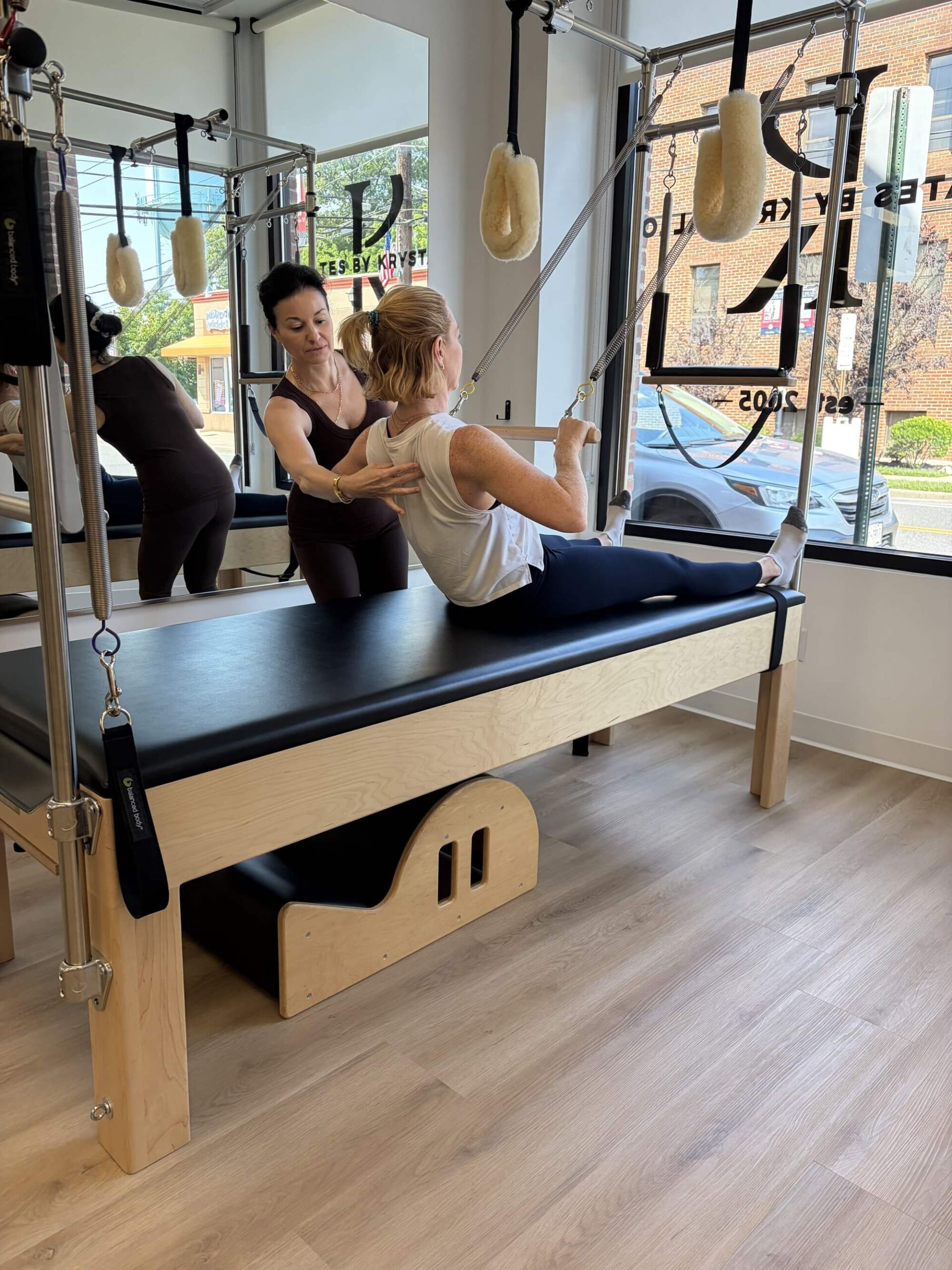
Krystallo Halikiopoulos (left) working in her own studio with a client on the Cadillac, a classical piece of Pilates apparatus (New York, 2026).
Looking back, she no longer separates those chapters of her life.
“The work was different, but the purpose was exactly the same.”
Today, she sees the connection clearly:
“As a lawyer, I advocated by uncovering truth and giving people a voice. Today, I advocate by helping people better understand their bodies, regain confidence in movement, and improve their quality of life.”
Why She Chose CSP Global’s Doctorate in Kinesiology Program
After more than two decades of clinical practice, Krystallo realized she wanted something more than another academic credential. She wanted to understand the science behind what she observed every day in her studio.
“I chose Concordia St. Paul because I wanted more than another degree. I wanted to become a better thinker. I’ve never been interested in collecting credentials. I’ve been interested in collecting understanding.”
That search for greater understanding led her to CSP Global’s kinesiology doctoral program. The program has challenged her to think differently, question assumptions, evaluate evidence more carefully, and approach movement through a broader scientific lens. Unsurprisingly, she has discovered unexpected similarities between research and her years in the courtroom.
“In many ways, doctoral research reminded me of practicing law. In both disciplines, you gather evidence, challenge assumptions, examine competing ideas, and continue asking questions until the picture becomes clearer.”
For Krystallo, one aspect of the program stands above the rest: curiosity. CSP Global fosters a mindset that continues to shape both her research and her clinical practice. “The program never asks us simply to learn research. It challenges us to question it.”
The Experience of an Online Doctorate in Kinesiology
Although flexibility initially drew her to an online doctorate in kinesiology, what surprised her most was how connected she felt throughout the experience.
“One of the biggest surprises for me has been how connected I’ve felt despite the program being completely online.”
She credits that sense of connection to faculty who are deeply invested in helping students grow, not only as researchers, but also as professionals. “The faculty have created an environment that is engaging, collaborative, and genuinely supportive. There is a real sense that everyone wants you to succeed, not simply earn a degree, but become a better professional and scholar.”
She also appreciates the intentional design of the curriculum, where every course builds upon the last and contributes to students’ growth as researchers.
“Every course feels purposeful. Rather than feeling like isolated classes, they build upon one another in a logical progression. Each assignment prepares you for the next, and every semester contributes to your larger development as a researcher.”
As someone who owns a business and often works seven days a week, Krystallo finds the coursework has become something she genuinely looks forward to. “Instead of adding stress to my day, it often brings clarity.”
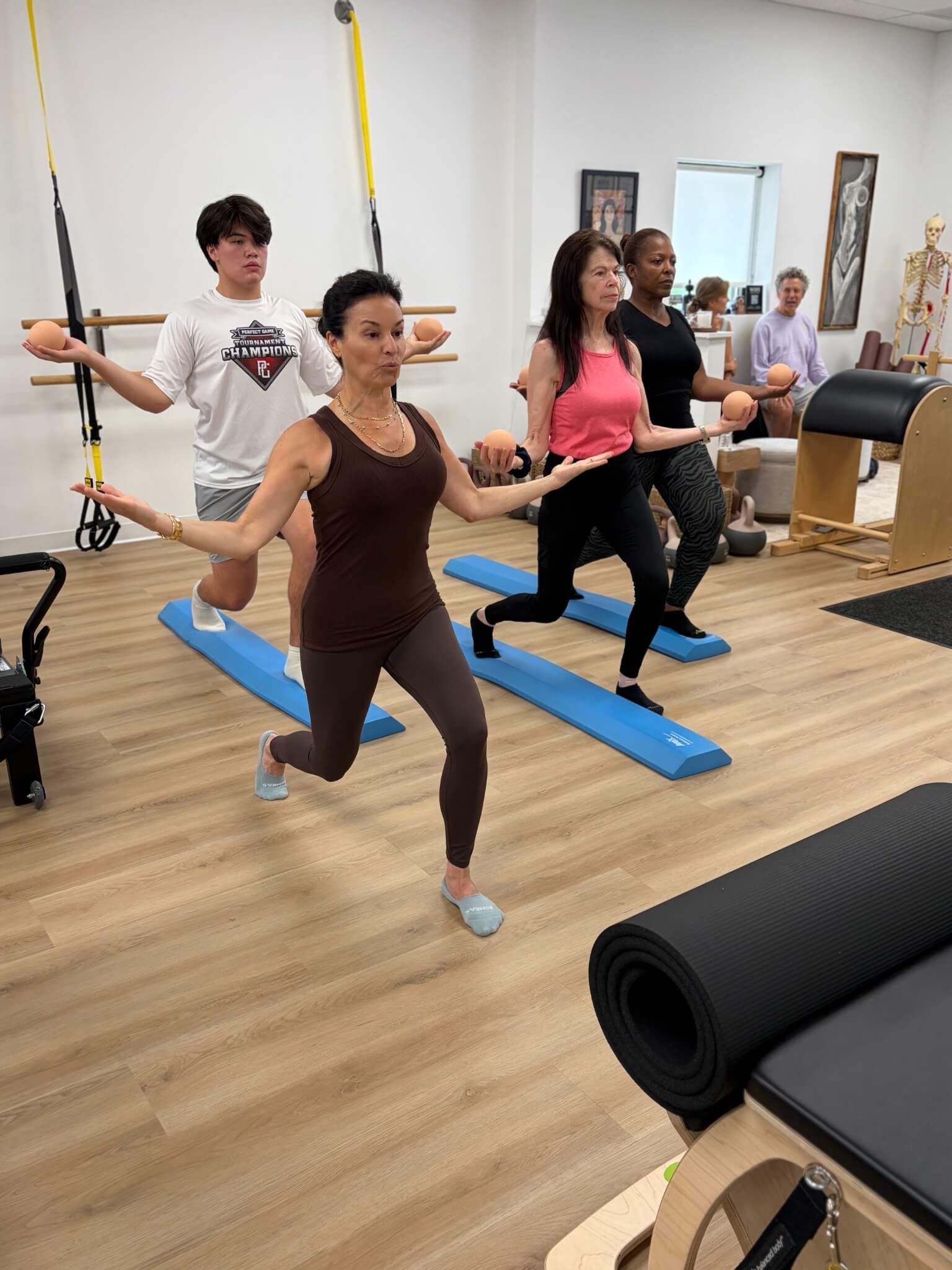
Movement Across the Lifespan: Krystallo Halikiopoulos (front left) leading balance and movement training with three clients: a college athlete, a 60-year-old professional, and an 80-year-old active adult.
Just as importantly, the learning never stays in the classroom. “Everything I learn can be applied immediately in my studio, and every day in my studio gives me new questions to bring back into the classroom.”
That continuous exchange between research and practice has become one of the most meaningful aspects of her doctoral experience. She hopes prospective students won’t let the online format discourage them.
“I have never felt that the lack of a physical classroom diminished the quality of my education. The relationships with faculty, the thoughtful course design, and the level of engagement have made the experience feel personal, connected, and academically rigorous.”
Dissertation Research Exploring Movement and Human Performance
Krystallo’s dissertation research reflects the same curiosity that has defined her entire career. Rather than simply asking whether Pilates works for individuals with chronic non-specific low back pain, she wants to explore a deeper question. “I became interested in asking a different [question]. What is actually changing during movement?”
Throughout years of clinical practice, she has observed changes that have extended far beyond strength or flexibility. “I observed people becoming more aware of their bodies, more coordinated, more confident in their movement, and better able to direct their attention.”
Those observations inspired her to examine how motor learning, neuroscience, biomechanics, psychology, and rehabilitation intersect during movement. The process reminded her of another familiar setting. “In many ways, it reminded me of preparing for trial.” Krystallo explains: “You keep examining the evidence until patterns begin to emerge that others may have overlooked.”
Her hope is that this applied kinesiology research offers clinicians another way to understand movement; not by replacing existing knowledge, but by connecting ideas that have traditionally existed in separate disciplines.
Research, Publishing, and Future Kinesiology Careers
Since starting her doctoral degree at CSP Global, Krystallo has also expanded her Pilates studio, joined the Advisory Board for PilatesStyle magazine, and published feature articles exploring the relationship between cognition, psychology, biomechanics, and movement.
One article, Before the Muscles Get Stronger, the Mind Gets Smarter, explores the importance of cognitive and psychological processes in movement. The second, Biomechanics: Moving Beyond the Word, encourages readers to think about biomechanics within the broader context of human movement rather than as isolated mechanical events.
Still, she believes learning extends far beyond any single degree.
“Learning has never been a requirement for me. It’s become a way of life.”
That philosophy has led her to study disciplines ranging from strength and conditioning and corrective exercise to yoga, breathwork, women’s fitness, healthy aging, foot biomechanics, and meditation. Each field, she believes, offers another perspective for understanding human movement.
As she looks toward the future, her goals remain remarkably consistent with the values that have guided her from the beginning. Krystallo plans to continue teaching, mentoring, researching, publishing, and working directly with clients while helping bridge the gap between science and clinical practice. She also hopes to make evidence-based movement education more accessible to everyone.
“Movement is universal. It belongs to everyone.”
Ultimately, she measures success not by titles or accomplishments, but by impact.
“If my research, my voice, or my teaching can help make evidence-based movement education more accessible to people who might never otherwise have that opportunity, then I will consider that one of the most meaningful accomplishments of my career.”
When asked what advice she would offer future doctoral students, Krystallo’s answer reflects the philosophy that has guided her entire journey: “Stay humble. Stay curious. Never believe you’ve learned enough.”
For Krystallo, every chapter of life from the courtroom to the studio to the research lab has been connected by a single purpose. As she puts it: “Advocacy has always been my profession. Only the language has changed.”
Ready to Advance Your Knowledge in Kinesiology?
Interested in pursuing an EdD or PhD in Kinesiology? Learn how CSP Global’s Doctorate in Kinesiology program helps working professionals deepen their expertise in research, leadership, human performance, and movement science.