

Since the early days of modern, organized sports, women have fought for equity in sports, from equal wages among male and female athletes to simply the right to take the field. From modern-day superstars like Serena Williams, Simone Biles, and Megan Rapinoe, to the early advocates for women’s place in sports, female athletes have been making their mark on athletics for centuries.
For today’s learners, especially those balancing careers, family, and education through flexible online programs, this history is more than a story. It’s a foundation for understanding how sport, health, and human performance continue to evolve.
Ancient Women in Sports
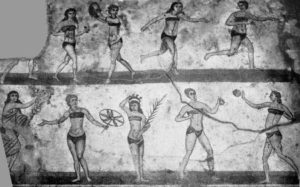
Image source: faculty.elmira.edu
While less common in many cultures, there were ancient women who participated in sports. In Homer’s Odyssey, he tells the story of Odysseus waking up to the sound of Princess Nausicaa and her handmaidens playing ball with one another on a riverbank.
In Ancient Greece, women were able to participate in foot races at some festivals, and could win Olympic victories through equestrian events, though they were forbidden from all other Olympic events. Spartan women participated in sports as men did; wrestling, javelin throwing, foot racing, and discus were all standard for women to compete in.
Additionally, certain tribes in Africa were known for allowing women to compete in wrestling arts. Women could participate in Laamb, a Senegalese wrestling style, up until the 20th century, when it became institutionalized, and women were banned. Additionally, women in the Key Faduy tribe in south central Sahara participate in a ritual competition to celebrate coming of age and demonstrate female power.
Native American and indigenous women were also believed to have participated in the same sports that men did, many of which were ceremonial, religious, or ritual events, and many ran foot races and participated in ball sports.
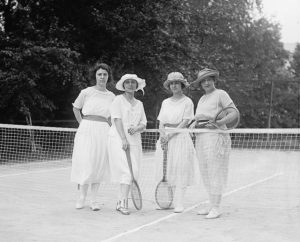
Image source: womenshistory.org
Victorian Age Ideals And Limitations On Women
The Victorian era in Western Europe ushered in an era of immense sexism. The “ideal” Victorian woman was seen as gentle and fragile, and any form of strenuous activity was strongly discouraged. Myths surrounding women included those that women could harm their reproductive organs if they participated in sports, which would make them unattractive to men, and that they only had a finite amount of energy in their bodies, and wasting that energy on sports or higher education would lead to weak offspring.
Despite this, in the late 1800s and early 1900s, informal athletic clubs had begun to form, and in the 1900 Olympics, 22 women competed alongside men in events such as sailing, croquet, and equestrian sports. They also participated in tennis and lawn golf, which were designated as women-only events.
In 1922, the first Women’s Olympic Games took place in Paris, where women competed in more physically demanding events such as shot put and the 1000-meter dash. However, there was a strong pushback against women running any further than 200 yards, as longer distances would cause women to appear out of breath.
By 1920, 22 percent of universities in the US had women’s athletic programs. However, most of these programs were replaced with game days and fitness classes due to societal pushback in the 1930s.
The 1940s, particularly during World War II, saw the introduction of the first women’s professional sports league, with the All-American Girls Professional Baseball League. Although holding strict standards for how women had to dress and act, it was seen as a major step forward for women in professional sports.
Title IX and the Fight For Equality
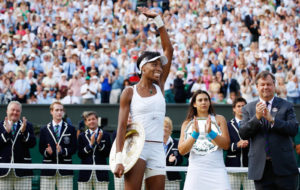
Image source: nytimes.com
While the 1950s and 60s saw some advancements for women in sports, particularly at the Olympic level, where the United States sought to respond to the powerful, athletic women that the Soviet Union had put forth to compete, it wouldn’t be until the passage of Title IX of the Education Act in 1972 that women were allowed equal opportunity in education and in sport.
Prior to Title IX, there were fewer than 30,000 collegiate athletes in the US. By 2012, that number had risen to 190,000. Involvement in sports at the high school level went from 295,000 in 1971 to 2.8 million in 2002–03.
While equal access to opportunity in sports is guaranteed under law, the fight for true equality continues to this day. At the Olympic level, women who performed well were often subject to gender confirmation exams from the 1968 Olympics until the late 90s, when the practice was officially abolished in 1999. Even so, the International Association of Athletics Federations required mandatory tests for high testosterone for female athletes in 2011, while no equivalent testing has been demanded for male athletes.
Pay inequity in sports for female athletes has also been a point of contention in recent years, as women were earning lower wages as athletes in organizations such as the WNBA, USA Hockey, and the United States Soccer Federation, and earning less prize money in competitions such as Wimbledon and the World Surf League’s Championship Tour.
Despite barriers, women have fought — and continue to fight — to be seen as equal in their athletic capabilities.
Empowering Change: Explore CSP Global’s Sport Management and Kinesiology Programs
Understanding the history of women in sports provides valuable context for today’s professionals working in kinesiology, sport management, and exercise science. Whether you’re advancing your career or transitioning into the field, this perspective helps shape more informed, inclusive leaders in sport and health industries.
As we reflect on the journey of women in sports, from ancient participation to modern advocacy, their resilience continues to shine through.
Inspired by their achievements? CSP Global’s online sport management and kinesiology programs are designed for working professionals ready to make an impact. With flexible, career-focused coursework, you can build the skills to lead, advocate, and innovate in today’s evolving sports landscape.
Join us in shaping a future where every athlete’s potential is valued.