

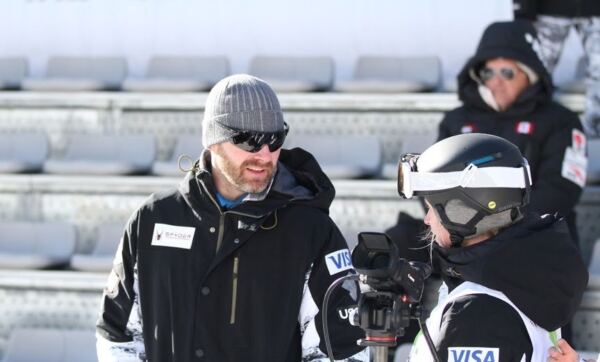
Dr. Joshua Bullock (left) at the FIS World Cup event in Thaiwoo, China, with U.S. Ski & Snowboard during competition operations.
For Dr. Bullock, the pursuit of a doctoral degree was never about stepping away from practice. It was about strengthening it. He recently completed his PhD in Kinesiology with an Exercise Science emphasis through CSP Global, bringing together years of experience across sport science, strength and conditioning, rehabilitation, and high-performance systems.
Over the course of his career, he has worked in a variety of elite performance settings, including collegiate athletics, U.S. Ski & Snowboard, and now Intermountain Health, where he currently serves as both a coach and sport scientist.
“Much of my day-to-day work involves coaching, testing, interpreting performance and biomechanical data, and translating those findings into practical decisions for athletes, clinicians, and other performance professionals,” he explained.
Bridging the Gap Between Practice and Scholarship
In addition to supporting athletes through performance training and assessment, Dr. Bullock also leads a system-wide Sports Science and Sports Performance Workgroup focused on creating stronger alignment across multiple sites within Intermountain Health. “Through that work, we are developing shared frameworks that better connect sports medicine, rehabilitation, biomechanics, and performance training across the system.”
This year, Dr. Bullock is creating greater consistency in how athletes are assessed, how data is interpreted, and how professionals collaborate across rehabilitation, return-to-sport, and performance settings. “The purpose of the workgroup is to create a shared framework for sports performance and sport science across multiple sites,” he explained.
“I am proud of this work because it reflects what I care most about professionally: building systems that help clinicians, coaches, and athletes make better decisions together.”
His experience at CSP Global sharpened how he approaches research, communication, and evidence-based practice. “The program influenced my personal and professional journey by helping me become more disciplined in how I think, write, and evaluate evidence,” Dr. Bullock explained. “I had nearly 20 years of applied experience before entering the program, but the doctoral process helped me sharpen the connection between practice and scholarship.”
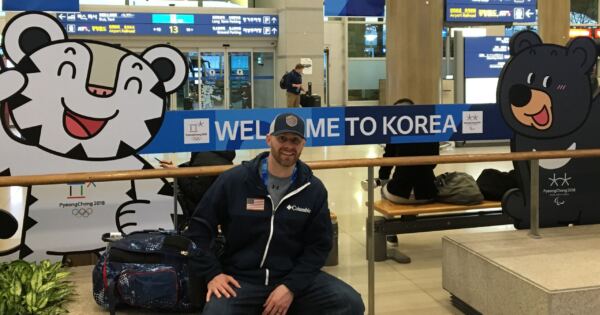
Dr. Joshua Bullock arriving for the 2018 Olympic Winter Games in PyeongChang, Korea, working with U.S. Ski & Snowboard during Olympic competition.
The process also reinforced something equally important: persistence. “A doctoral program is not simply an academic exercise,” he said. “It tests your time management, humility, resilience, and ability to keep going when progress feels slow and unforeseen challenges arise.”
For him, sport science is about far more than technology or testing: “At its best, it is about creating shared understanding across disciplines so that athletes receive better care.”
Applying Dissertation Research to Elite Athletics
Dr. Bullock’s dissertation focused on jump performance and force-power profiling in elite mogul skiers competing on the U.S. Ski & Snowboard National Team. His dissertation was titled “Force-Power Profiles and Countermovement Utilization Ratios in U.S. Ski & Snowboard National Team Athletes.” The project examined squat jump and countermovement jump performance metrics, including jump height, peak force, peak power, and countermovement utilization ratios.
His motivation for pursuing this topic came directly from his applied work with athletes. “In high-performance settings, we often collect jump data, force plate data, and other performance metrics.” But for Dr. Bullock, the challenge was never simply collecting data; it was understanding how to interpret it meaningfully. “The harder question is how to interpret those data in a way that is meaningful for coaches, clinicians, and athletes.”
Check out Dr. Joshua Bullock in the CSP Kinesiology Real Talk Podcast, “The Future of Kinesiology: Trends Shaping the Next 5-10 Years”
His interest in countermovement utilization ratios stemmed from their potential to better understand how athletes produce force and express power. “Rather than treating jump metrics as isolated numbers, I wanted to better understand how the relationship between measures could help inform athlete profiling.” Today, the project continues to shape how he approaches both rehabilitation and performance decision-making. “The dissertation absolutely remains connected to my current work,” he said. “The project strengthened my belief that data are only useful when they are interpreted carefully and translated into action.”
Balancing Career Demands with Doctoral Rigor
Like many working professionals, Dr. Bullock pursued his doctorate while balancing career responsibilities, industry leadership roles, and family life. “My journey toward a doctoral degree was not linear,” he shared.
Like many working professionals, Dr. Bullock needed a program that wouldn’t force him to pause his career. He found that CSP Global’s online format allowed him to apply his doctoral work directly to the field in real time.
“I chose CSP because the program was designed to respect the realities of working professionals while also allowing me to pursue my personal research and performance interests,” Dr. Bullock said. “I needed a doctoral program that was academically rigorous, but also flexible enough to allow me to continue growing in my career while pursuing the degree. CSP offered that balance.”
The applied relevance of CSP Global’s PhD in Kinesiology program allows students to immediately connect academic coursework and dissertation research directly to their professional practice, making it an ideal fit for active clinicians and coaches. “The best part of the program was its applied relevance. The coursework and dissertation process allowed me to immediately connect academic content directly to my professional work.”
He also credits the faculty for creating a supportive environment that challenged students while understanding the demands of professional careers. “What I valued most was the support from faculty and the flexibility of the program structure,” he said. “The faculty understood that many doctoral students were also professionals with demanding careers.”
That support became especially meaningful during the dissertation process. “My committee chair, Dr. Hamilton, is one of the most supportive and caring people I have ever met,” he shared. “Even when the process felt challenging, her belief in me never wavered.” For Dr. Bullock, the rigor and mentorship of the program continue to influence how he leads and collaborates professionally today. “That combination of rigor, encouragement, and steady mentorship is something I carry directly into my current professional role.”
Advice for Future Kinesiology Scholars
As he reflects on his doctoral journey, Dr. Bullock encourages future students to pursue questions that genuinely matter to them.
“My advice is to start with a question that genuinely matters to you. Doctoral work is too demanding to be sustained by obligation alone.”
He emphasizes the importance of consistency and organization throughout the process, noting that the dissertation process “rewards consistency more than intensity.”
His top advice for future scholars includes:
- Start with passion: “Start with a question that genuinely matters to you. Doctoral work is too demanding to be sustained by obligation alone.”
- Pace yourself: “Small, steady progress matters.”
- Stay engaged: “Read regularly. Write before you feel ready. Ask questions.”
- Embrace the edits: “Accept feedback without taking it personally.”
Going forward, Dr. Bullock plans to continue advancing integrated sport science and performance systems within both healthcare and high-performance environments. He is especially interested in leadership and in the continuum of rehabilitation and elite performance. He also plans to continue teaching, presenting, writing, and contributing to professional education while serving as the Utah State Director for the National Strength and Conditioning Association.
Long term, his vision is centered on creating stronger collaboration between sport science, rehabilitation, strength and conditioning, and medicine.
“The goal is not simply to collect more data or add more technology,” Dr. Bullock said. “The goal is to help people make better decisions, support safer progression, and improve the human experience of performance and recovery.”
Reflecting on his doctoral journey, he remains grateful for the role CSP Global played in both his personal and professional growth. “CSP was an important part of my professional and personal development, and I am grateful for the opportunity to reflect on that experience.”
Are you ready to elevate your career in sport science and human performance? Discover how the online PhD in Kinesiology at CSP Global can help you bridge the gap between advanced research and applied practice. Explore the program details and start your journey today by visiting our Doctorate in Kinesiology program page.